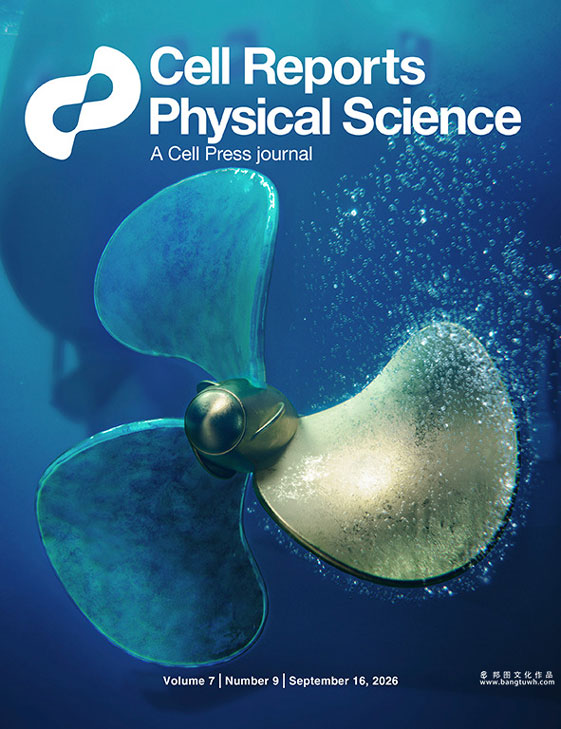
Hydrogel coatings suppress cavitation by raising the nucleation barrier
Coated propellers show reduced cavitation erosion and higher thrust
Hydrated interfaces delay cavitation onset and reduce broadband noise
Performance is retained after 30 days in artificial seawater
Summary
Cavitation is an undesirable phenomenon in hydrodynamic systems, leading to surface erosion, efficiency degradation, and intense acoustic emissions. Existing research efforts have primarily focused on mitigating cavitation-induced impacts but have rarely addressed cavitation initiation. Here, we propose a hydrogel coating that raises the energy barrier for heterogeneous nucleation while retaining the capability to dissipate impact energy during bubble collapse. When applied uniformly to hydrodynamic surfaces, it exhibits robust adhesion, durability, and structural stability under hydrated conditions. The hydrogel coating maintains a thrust enhancement of approximately 3.4% under cavitating flow and elevates the onset speeds for incipient and developed cavitation, resulting in a 31.3% increase in maximum thrust under cavitation-free operation and a 27.8% increase before developed cavitation. Additionally, the coating attenuates broadband noise by up to 12.8 dB. This hydrogel-based strategy may be extended to other hydrodynamic systems where cavitation suppression is required.